Demosthenes
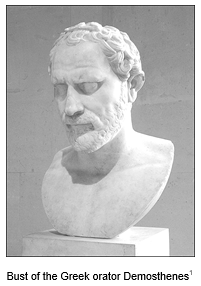
Demosthenes (384BC–322BC) was a prominent Greek statesman and orator of ancient Athens. His orations constitute the last significant expression of Athenian intellectual prowess and provide a thorough insight into the politics and culture of ancient Greece during the 4th century BC.
As a boy Demosthenes had suffered from a speech impediment, and an inarticulate and stammering pronunciation. According to Plutarch, he also had a weakness in his voice, "a perplexed and indistinct utterance and a shortness of breath, which, by breaking and disjointing his sentences much obscured the sense and meaning of what he spoke."
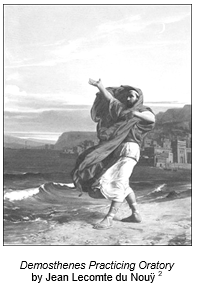
Demosthenes soon undertook a disciplined program to overcome these shortcomings and improve his locution. He worked on his diction, his voice and his gestures. Demosthenes used to study in an underground room he constructed himself. He also used to talk with pebbles in his mouth and recited verses while running. To strengthen his voice, he spoke on the seashore over the roar of the waves.
Demosthenes learned rhetoric by studying the speeches of previous great orators. He delivered his first judicial speeches at the age of twenty. He grew interested in politics during his time as a professional speech-writer and in 354 BC he gave his first public political speeches. He would go on to devote the most productive years of his life to opposing Macedon's expansion.
Demosthenes’ language was simple and natural, never far-fetched or artificial. He was a true artist who could make his art obey him. The main criticism of Demosthenes' art, however, seems to have rested chiefly on his known reluctance to speak extempore; he often declined to comment on subjects he had not studied beforehand. However, he gave the most elaborate preparation to all his speeches and, therefore, his arguments were the products of careful study. He was also famous for his caustic wit.
According to Cicero, Demosthenes regarded “delivery” (gestures, voice etc.) as more important than style. He made efficient use of his body to accentuate his words. Thus he managed to project his ideas and arguments much more forcefully.
According to the classical scholar Harry Thurston Peck, Demosthenes “affects no learning; he aims at no elegance; he seeks no glaring ornaments; he rarely touches the heart with a soft or melting appeal, and when he does, it is only with an effect in which a third-rate speaker would have surpassed him. He had no wit, no humour, no vivacity, in our acceptance of these terms. The secret of his power is simple, for it lies essentially in the fact that his political principles were interwoven with his very spirit.”
The Alexandrian Canon compiled by Aristophanes of Byzantium and Aristarchus of Samothrace recognized Demosthenes as one of the 10 greatest Attic orators and speech-writers. According to Longinus, Demosthenes “perfected to the utmost the tone of lofty speech, living passions, copiousness, readiness, speed.” Cicero acclaimed him as “the perfect orator” who lacked nothing, while Quintilian extolled him as “lex orandi” (“the standard of oratory”) and underscored that “inter omnes unus excellat” (“he stands alone among all the orators”).
This article uses material from the Wikipedia article "Demosthenes" (http://en.wikipedia.org/wiki/Demosthenes) and is licensed under the GNU Free Documentation License (http://www.gnu.org/copyleft/fdl.php). Please see here for full attribution.


 Import citation into