Tip 30: Decide on the most appropriate format
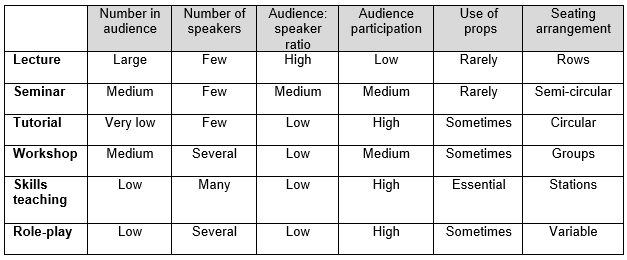
If you have a choice over the format of your presentation, think about which format will help you to achieve your objectives for that event. It may be that you are not given the freedom to decide on the format, and must prepare as best as you can.
Lecture
Lecturer stands in front of an audience and talks about the subject matter while the audience passively listens.
Advantages: A quick, cheap and traditional way of conveying a large volume of information to a large number of people.
Disadvantages: Tedious for the audience. Difficult for participants to ask questions or check understanding. Largely superseded by more efficient methods of information transfer such as textbooks, the internet and handouts. Not an effective method for promoting thought, changing attitudes, or teaching behavioural skills.
Seminar
Instructor leads a group of people through a discussion on a particular subject and everyone present is requested to actively participate.
Advantages: Allows for an exchange of ideas between members of the group. The instructor is a facilitator. Encourages critical thinking and dialogue.
Disadvantages: The members of the group must all start with a similar level of background knowledge. Labour-intensive and expensive.
Tutorial
Tutor discusses a pre-defined topic with the tutorial group which is expected to have previously researched the topic and prepared questions and insights for discussion.
Advantages: Allows tuition to be highly customised to the learning needs of the tutorial group. The tutor can give individual attention to each student.
Disadvantages: Labour-intensive, time-consuming and expensive.
Workshop
Expert tutors impart problem-solving skills and convey attitudes and behaviours through practical examples and exercises. Participant involvement is expected.
Advantages: Real-life situations can be explored in a controlled environment. Participants can seek solutions to their own problems from experts.
Disadvantages: Labour-intensive and expensive. Tutors possessing extensive experience and knowledge are required.
Skills teaching
Tutors teach practical procedures through a combination of lectures, demonstrations, supervised practice, observation and examination. Hand-on audience participation.
Advantages: Allows rapid, efficient and standardised teaching of practical skills in a safe environment.
Disadvantages: Labour-intensive. Suitable training materials may be expensive. Tutors must first undergo training and assessment in the skills which are to be taught.
Role-play
Members of the audience take turns to play different roles in pre-planned scenarios which are designed to highlight and illustrate relevant vocational learning objectives.
Advantages: Participants are able to examine and learn from their own and each other’s experiences and responses to given situations.
Disadvantages: Instructors may find it a challenge to devise realistic yet controllable scenarios. Participants’ behaviour in role may not reflect their real-world behaviour.
« Previous: Tip 29: Have a logical, clear structure
Next: Tip 31: Decide the best level of audience participation? »


 Import citation into